Philosophy / Version 01 / April 2025
P.S.
On curiosity, systems, people, and why there's always more beneath the surface.
This page is called P.S. for a reason.
Before Wiyc had a name — before fudge, before samarai, before any of the things you might be here to read about — there was a notebook. In the notebook, on a page I had been staring at for weeks, I wrote two words: Problem and underneath it, Solution. Then I drew a line between them, and then another line back, and realised the line made a loop.
The problem I was trying to solve was how to explain what I wanted to build. The solution, I eventually understood, was that the explanation and the thing were inseparable. You cannot pitch a company that exists to improve how problems get solved without the pitch itself being an instance of problem-solving. The form has to contain the function. The medium has to carry the method.
I called that loop P.S. — Problem Solution — and then noticed it also meant Perfect System, and also Post Script, which is what you write when the letter is done but you have more to say. That felt right. There is always more to say.
P.S. became Wiyc. What If You Could — a question aimed outward at anyone who encounters it, and inward at myself every morning. This page is my attempt to explain not what we are building (that changes) but why we are building it and what principles we refuse to abandon while doing so.
I should warn you: this is not a mission statement. It is not a set of corporate values designed to look good on a wall. It is closer to a set of field notes from someone who has spent most of his life feeling that the world is more interesting than the version of it we are usually presented with, and who decided to do something about that rather than simply complain.
If you read the whole thing and disagree with most of it, we are probably not meant to work together. That is useful information for both of us.
— Rajdeep
The form must contain the function. If you cannot explain it by demonstrating it, you do not understand it yet.
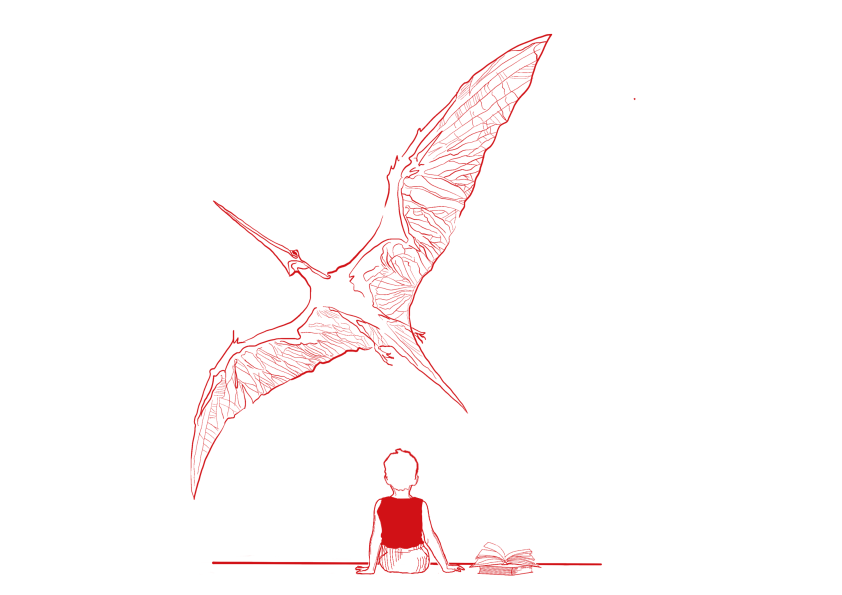
Dinosaurs are real.
1.When I was a child in Kolkata, I was obsessed with many things in quick succession. Dinosaurs were the first obsession I can still feel in my body. Not because they were big or scary — though they were — but because they were evidence. Evidence that the world was older than anyone had told me, that the room I was sitting in was a thin layer of paint on top of something vast and strange and not remotely interested in my comfort.
2.A single fact could rearrange reality. I remember the afternoon I learned that birds were dinosaurs — not descended from, but actually were — and for the rest of the day I looked at sparrows differently. The ordinary had become impossible. The impossible had become ordinary. That inversion is the most addictive feeling I know.
3.The pattern behind my childhood obsessions was always the same: encounter something, fall into it completely, and then — before the falling was finished — sense that there was a deeper room beneath the one I was in. Dinosaurs led to geology. Geology led to the age of stars. The age of stars led to the question of whether anything lasts, and what "lasting" even means when the timescales are that large.
4.I think most children feel this way, and most adults are taught to stop. Not by anyone in particular, but by the slow accumulation of efficiency. You learn that questions have answers, and that the point of school is to learn which answers go with which questions, and that the people who succeed are the ones who answer quickly and move on. Curiosity becomes a phase rather than a practice.
5.For a while, the internet made this worse for me personally. Short-form content, infinite scroll, the dopamine of knowing a little about everything and a lot about nothing. My attention span shortened. My patience for staying with a difficult idea eroded. I noticed this happening and I hated it, which is part of why I eventually decided to build tools that work differently.
6.But before that realisation came years of simply following the thread. And the thread always led the same way: down, beneath, into the thing underneath the thing.
Stay with the question long enough for it to become yours. The point of curiosity is not to collect answers but to deepen the quality of your confusion.
Everything leads to philosophy.
1.The first door I found into that deeper room was a programming language called LOGO. I was perhaps seven. You typed commands — FORWARD 50, RIGHT 90 — and a small triangle on the screen drew lines. It was the closest thing to magic I had experienced. You spoke to the machine in its language and it obeyed, and the obedience was visible. A line appeared. A shape formed. You had made something from nothing but instructions.
2.But what I remember most is not the shapes. It is the questions the shapes created. If this triangle can draw a square, what else can it draw? If this language can do this, what can other languages do? If the screen shows this, what is happening behind the screen that I cannot see? The visible thing was the doorway. The invisible architecture behind it was the room I wanted to enter.
3.That instinct — the compulsion to look behind — is what led me to Wikipedia. I do not remember exactly when I started reading it, but I remember the feeling of the first long evening spent following links. You begin with one article, and by midnight you are somewhere you could not have predicted. The path is not random; it has its own logic, a logic that emerges from the structure of knowledge itself rather than from anyone's plan.
4.There is a well-known phenomenon: if you click the first significant link in almost any Wikipedia article and keep clicking, you eventually arrive at the page for Philosophy. It is not a rule and it does not always hold, but the tendency is real, and it is produced not by any central design but by the way definitions work — each concept is defined in terms of more fundamental concepts, and fundamentality has a direction, and that direction leads to the questions that philosophy asks.
5.When I learned this as a child, I did not understand it in those terms. I understood it as a feeling: that everything was connected, that the connections had a shape, and that the shape was not arbitrary. That became one of the deepest intuitions behind what we are now building.
6.Wiyc is not a single product or a single app. It is an attempt to build a system of systems — software, compute, data, intelligence, people — where the connections between them matter as much as the components themselves. We are not trying to build five separate businesses and staple them together with a brand. We are trying to create a structure where each part makes the others more coherent, the way Wikipedia's hyperlinks create emergent paths toward fundamental questions.
7.This sounds ambitious to the point of arrogance. It might be. But I have seen the alternative — companies that are collections of disconnected products held together by nothing but shared billing — and I do not think that is where the interesting work happens. The interesting work happens when things connect in ways that were not planned but are not accidental either.
Good systems produce coherence through many local decisions, not one central plan. Build for emergence. Trust the connections.
There is a universe in your head.
1.If the outer world was connected in ways I could trace — link by link, concept by concept — then surely the inner world was too. I must have been nine or ten when I read Harry Potter for the first time. Like millions of others, I disappeared into it. But the thing that stayed with me was not the plot. It was the realisation that a human mind could contain a world that detailed, that consistent, that alive. Not J.K. Rowling's mind — mine. The world existed in my head while I read, and it was indistinguishable from experience.
2.This led to a period — years, really — where I tried on identities like clothes. After every book, after every film, I had a new role model. A scientist after reading Feynman. A philosopher after discovering Pessoa. A musician after a particular album. I do not think this was instability. I think it was research. You cannot discover your own principles without first testing other people's.
3.Fernando Pessoa — the Portuguese poet who wrote under dozens of different names, each with its own biography, style, and worldview — became important to me later for exactly this reason. He understood that a self is not a fixed point but a practice. You construct it through attention. You maintain it through choices. And the choices that matter most are not the dramatic ones but the daily ones: what you notice, what you return to, what you refuse.
4.Eventually, the question shifted. It stopped being "Who should I become?" and started being "What principles would let me act with coherence across all the different things I want to be?" Not a question you answer once and file away. A question you live inside.
5.Wiyc is the same kind of experiment, applied to a company rather than a person. The central question is simple, even if the answer is not: what happens if the tools and environments people work in are designed to expand what they are capable of, rather than to extract what they already know how to do? That question guides our architecture, our hiring, the way we think about the relationship between a product and the person using it. It shows up in every design decision, every policy, every piece of code — imperfectly and continuously.
Identity is experimental. Build environments that make better versions of people more likely, and give them the freedom to discover what "better" means for themselves.
Things that last.
1.But environments only matter if they survive long enough for the people inside them to grow. David Deutsch writes about the age of the Earth and the stars with a precision that rearranges your sense of proportion. The numbers are not the point — 4.5 billion years, 13.8 billion years — the point is what the numbers do to your sense of what matters. When you genuinely absorb the timescale of reality, the things that seem urgent on a Tuesday morning look different. Not unimportant. But differently important. You start asking not just "Does this work?" but "Will this still work in ten years? In fifty? In a hundred?"
2.The Lindy Effect is a heuristic for this question. It says: if a non-perishable thing has survived for a certain amount of time, the best prediction is that it will survive for approximately that much more time. Books that have been read for a century are likely to be read for another century. Technologies that have endured for decades are likely to endure for decades more. The things that have lasted are not necessarily better in any abstract sense — they are more robust. They have survived the test of time not by being optimal but by being adaptable, or simple, or deeply matched to a need that does not change even when everything around it does.
3.I think about this constantly when making technical decisions. We chose local-first architecture for fudge — your data lives on your device, your work happens on your machine, the cloud is optional — not because it is easier (it is significantly harder) but because it is more durable. Centralised services come and go. Companies pivot, shut down, get acquired. But a file on your own computer is yours in a way that a file in someone else's cloud is not. Ownership is a form of durability.
4.The same logic applies to the broader Wiyc structure. We think in branches — Software, Compute, Data, Intelligence, People — not because we are trying to build a conglomerate but because the things that last are usually systems, not products. A single app is fragile. An ecosystem where software needs compute, compute generates data, data trains intelligence, and intelligence serves people — that has the self-reinforcing quality that Lindy rewards.
5.These are not future plans. The ideas on this page are not waiting to become real — they are being built, tested, and revised in working code every day. The gap between philosophy and engineering is one we are actively closing, and the early results give us reason to believe the architecture holds. But the ambition extends far beyond any single version or release. Thinking in terms of duration is not a promise about the future; it is a constraint on the present. It changes the decisions you make today when you believe the thing you are building might still exist when you are gone.
6.There is a related idea I find useful: the modern world has become very good at miniaturising things that should remain large, and centralising things that should remain distributed. Your data, your relationships, your attention, your health records, your financial history — all of these have been compressed into someone else's server and made subject to someone else's business model. The convenience is real. The fragility is also real. We think the next generation of infrastructure should reverse this pattern where it can: give people back the things that are theirs, and build the shared infrastructure on principles that do not depend on any single company — including ours — surviving.
Build for duration. Optimise for robustness over novelty, for ownership over convenience, and for systems that get stronger with time rather than more dependent on their creators.
1.4 billion names.
1.Everything I have said so far — about durability, ownership, distributed infrastructure — is about systems. But systems do not exist for their own sake. They exist for the people inside them. And this is where the abstraction meets something I feel in my chest every time I think about it. India has 1.4 billion people. I know what that sentence does: it makes you think of a number, and the number makes you think of a market, and the market makes you think of opportunity or challenge or logistics. That is how we have been trained to think about large populations. The number replaces the people.
2.I grew up in Kolkata, which is itself a city of roughly 15 million. You learn very quickly that the systems around you — the schools, the hospitals, the bureaucracies, the companies — do not have the capacity to see you as a specific person. You are a category: a student, a patient, a customer, a citizen. The category is efficient and the efficiency is necessary, but something is lost in the compression. What is lost is the thing that makes you different from every other member of the category. Your name. Your particular way of thinking. The specific problem only you would notice.
3.I do not have a solution to this at the scale of a country. But I have a conviction that the next generation of technology should make it harder, not easier, to reduce people to categories. Not through slogans about individuality but through architecture.
4.This conviction shapes everything we build. Our memory and reasoning framework — samar — is designed around the idea that intelligence should model the world the way a thoughtful person does: with nuance, uncertainty, context, and the acknowledgment that understanding is always incomplete. We are not trying to build a system that gives correct answers. We are trying to build one that knows what it does not know, tracks how its understanding changes, and treats each person's context as irreducible. The details of how — the architecture, the formal model, the early results — are for our research papers and technical writing. What matters here is the why: because people deserve systems that see them, not systems that categorise them.
5.When we build fudge for a doctor in Kolkata or a teacher in Zurich, the question is not "how do we give them a generic tool and let them adapt to it?" The question is "how do we build a system that adapts to them — their domain, their language, their workflow, their judgment — without pretending we know in advance what those things look like?" That is a much harder problem. It requires local-first architecture because their data must remain theirs. It requires modular design because a hospital in Kolkata and a vocational school in Switzerland have almost nothing in common except that the people inside both deserve tools that respect their intelligence.
6.Machines will become more capable than they already are. They will automate more, infer more, remember more. Good. Let them. But only — only — if that capability is arranged in service of the people using it, not the people selling it. If we build intelligence that makes doctors more dependent on our platform instead of more capable in their own judgment, we have failed, regardless of what the metrics say.
7.The People branch is not an HR department or a recruitment pipeline. It is the reason the other four branches exist. Software serves people. Compute empowers people. Data belongs to people. Intelligence extends people. If any of those verbs get reversed — if people start serving the software, or the data starts belonging to someone else — we have lost the plot.
Every number is a name. Build technology that makes it harder, not easier, to reduce a person to a category.
There is always more.
But if people are at the centre, then the question beneath all the other questions is: what does it actually mean to see a person — or anything — adequately? I return often to Spinoza for this. Not because I understand him fully — I do not, and I suspect that is part of the appeal — but because he offers something I have not found anywhere else: a vision of reality where everything is one substance, viewed through infinite attributes, manifesting in infinite modes, and the project of human life is to understand this more adequately over time.
That sounds abstract. Here is what it means to me concretely. A few years ago, I befriended a neighbour's dog — Kaiser. Within days I noticed the family was treating him horribly. To most people this would have registered as sad, maybe irritating, and then been forgotten. To me it became an obsession. Not a passing concern — a fire. I barely knew this dog, and yet the injustice of his situation consumed me the way a mathematical proof consumes someone who can see the error in it. I had to do something. I have always been this way: the things I encounter — beautiful or broken — enter me completely. I cannot look at them from a distance. When I see a dog, I do not see one thing. I see a companion, a biological organism, a being whose inner life I cannot access, a creature subject to someone else's power, a test of whether I act on what I believe or merely believe it. These are not different dogs. They are different attributes of the same substance. The more attributes I can hold simultaneously, the more adequately I understand. The more adequately I understand, the freer I become — and the harder it becomes to look away.
That way of seeing — holding many attributes at once, refusing to collapse a thing into one convenient label — is not just a personal habit. It is the philosophical foundation of everything we are building. Our intelligence research, our memory systems, our product architecture — all of it is shaped by the conviction that understanding means seeing more, not less. That the right response to complexity is not to simplify it away but to build systems capable of holding it. The specifics of how we are doing this are for our research and technical writing. What matters here is that the ambition is not decorative. It is structural. It changes the code we write and the decisions we make every day.
The five branches of Wiyc — Software, Compute, Data, Intelligence, People — are an attempt to build a company the way Spinoza described reality: as one substance with many attributes. The software is the tangible extension. The intelligence is the thought. The people are the modes — the specific, finite, irreplaceable configurations through which the whole thing actually lives. None of the branches makes sense alone. Together, if the connections work, they produce something more coherent than the sum of its parts — the way Kaiser was not five separate things but one being seen through five lenses.
I want to be honest about the scale of this bet. We are a small company in India trying to build infrastructure that a handful of trillion-dollar corporations currently control. The odds are not favourable. The ambition might be delusional. But I have a conviction — maybe the only one I am fully certain of — that the interesting things happen at the edges, in the spaces between what exists and what could exist, and that the question "What if you could?" is always worth asking even when the honest answer might be "You cannot."
There is always more to think. There is always more to say. There is always more to do.
Leave room for revision without losing the spine. Nothing here is finished. That is not a disclaimer. It is the method.
This page is Version 01. It will change. The principles will be tested and some will fail the test and be replaced by better ones. That is not a weakness; it is the method.
What if you could?
— Rajdeep Surolia